
یہ بھی دیکھیں


 03.07.2026 10:08 AM
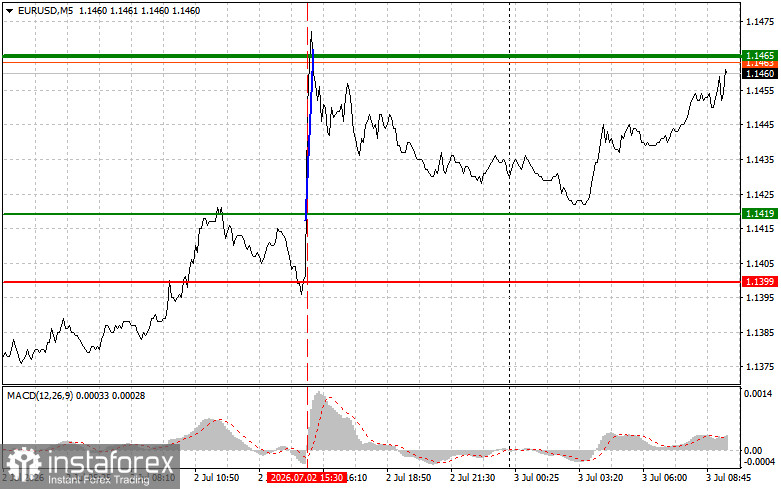
The test of the 1.1419 level occurred when the MACD indicator had just begun moving upward from the zero line, confirming a valid entry point for buying the euro. As a result, the pair advanced to the target level of 1.1465.
News that U.S. hiring slowed sharply in June triggered a steep decline in the dollar and strengthened the euro. This development sparked intense discussion among economists and analysts, as such dynamics run counter to the conventional relationship between employment and economic growth. A slowdown in job creation, combined with a decline in the unemployment rate, may indicate either that effective labor demand has been exhausted or that structural changes are taking place in the labor market. The foreign exchange market reacted with predictable emotion. The dollar's decline reflects traders' concerns about the future state of the U.S. economy. Slowing hiring is a warning sign that may point to an approaching economic slowdown or, at the very least, weaker economic growth.
The first half of today's trading session will feature several key events that could have a significant impact on the euro and European assets. Investors and analysts will focus on the Eurozone Services PMI, one of the leading indicators of economic conditions that reflects business sentiment and expectations in one of the economy's key sectors. The release of the Composite PMI, which combines data from both the manufacturing and services sectors, is expected to provide a more comprehensive picture of economic activity in the euro area. Any deviation from forecasts, whether stronger or weaker than expected, could lead to increased market volatility.
Additional uncertainty during today's trading session will come from a speech by ECB President Christine Lagarde. Her comments on the current economic situation, inflation trends, and the outlook for monetary policy will be closely analyzed for any new signals. Given the current environment, in which the European economy is trying to cope with inflationary pressures while balancing economic growth and price stability, Lagarde's remarks could become a key driver of short-term market sentiment.
As for my intraday strategy, I will primarily rely on the implementation of Scenario No. 1 and Scenario No. 2.
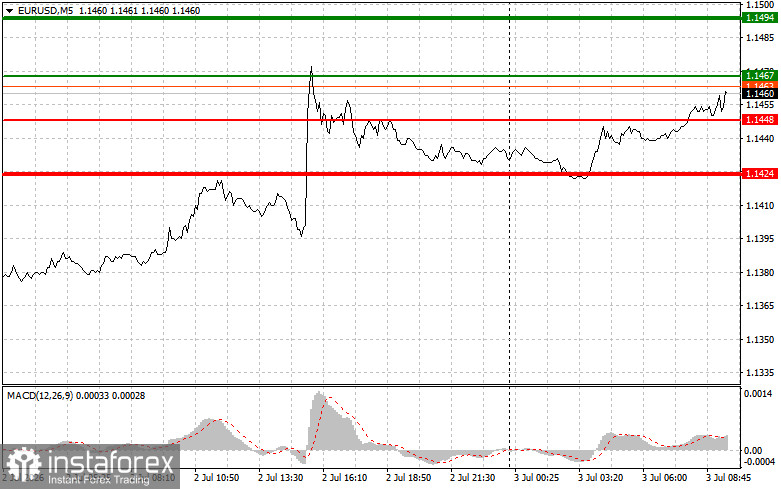
Scenario No. 1: Today, consider buying the euro when the price reaches 1.1467 (green line on the chart), with a target at 1.1494. At 1.1494, I plan to exit long positions and open short positions in anticipation of a 30-35 point pullback from the entry point. The euro is likely to continue rising only if the Eurozone data comes in stronger than expected.
Important: Before buying, make sure the MACD indicator is above the zero line and has just begun moving upward.
Scenario No. 2: I also plan to buy the euro if the price tests 1.1448 twice in succession while the MACD indicator is in oversold territory. This would limit the pair's downward potential and trigger a bullish market reversal. In this case, a rise toward 1.1467 and 1.1494 can be expected.
Scenario No. 1: I plan to sell the euro after the price reaches 1.1448 (red line on the chart). The target will be 1.1424, where I intend to exit short positions and immediately open long positions, expecting a 20-25 point rebound. Selling pressure on the pair is likely to return today only if the economic data disappoints.
Important: Before selling, make sure the MACD indicator is below the zero line and has just begun moving downward.
Scenario No. 2: I also plan to sell the euro if the price tests 1.1467 twice in succession while the MACD indicator is in overbought territory. This would limit the pair's upward potential and trigger a bearish market reversal. In this case, a decline toward 1.1448 and 1.1424 can be expected.
Important: Beginner Forex traders should exercise extreme caution when entering the market. It is generally advisable to stay out of the market ahead of major fundamental reports to avoid sharp price swings. If you choose to trade during news releases, always place stop-loss orders to minimize potential losses. Without stop-loss orders, you may quickly lose your entire deposit, especially if you trade large positions without applying proper money management.
Remember that successful trading requires a clear trading plan, such as the one outlined above. Making spontaneous trading decisions based solely on the current market situation is inherently a losing strategy for an intraday trader.


