
Vea también


 07.09.2026 10:38 AM
The euro and the pound sterling plunged sharply on Friday after US nonfarm payrolls were released, but the bearish momentum had completely evaporated by today. The immediate reactions of both currencies look perfectly logical, but I wouldn't rush to declare a trend reversal, because the key event for the dollar is not the NFPs published last week but a different story this week.
US nonfarm payrolls rose by 162,000 in August versus expectations of roughly a 55,000 increase, and the unemployment rate remained at 4.1%, unchanged from the prior month, according to the Bureau of Labor Statistics. The surprise—nearly three times the forecast—was enough on its own to strengthen the dollar, benefiting the US currency and the Fed's hawkish camp while penalizing risk assets and anyone positioned for rapid policy easing.
Even more important than the report itself was the revision to previous months. July's figure was revised up by 11,000 and June's by 44,000, which turned July's -23,000 into +21,000, and left total employment for the two months some 55,000 higher than previously published. In other words, the labor-market deterioration that underpinned expectations of easing simply didn't materialize, which removes any justification for the Federal Reserve to return to a dovish stance. Inflation won't allow such a pivot, and market-implied odds of a rate hike in September have moved back up—despite the topic appearing nearly closed just two weeks ago.
Why is the market pricing in tightening when leading employment indicators point the other way? Because policymakers are not yet paying much attention to those indicators. The ISM services employment index remains in contraction territory, and the manufacturing ISM also shows falling employment—but with the official payrolls print at +162,000 those signals look secondary to the rate-setting committee. Let me remind you that the July meeting ended with the funds rate held at 3.50–3.75% on a 9–3 vote, and the dissenters were explicitly voting for a rate hike; Friday's data gave that three-member bloc the argument they had been missing. The losers in this configuration are companies in the services sector, where hiring is already compressing, and the broader economy will pay the price in the form of more expensive money.
The final act will be US inflation data on September 11, and traders will be preparing for it all week. Acceleration in consumer prices will cement a September rate hike as a done deal and give the dollar another leg higher versus the euro and the pound sterling; a slowdown would reset the committee's internal debate and quickly wipe out Friday's dollar-bull optimism. Until those figures are out, I don't expect the market to open seriously large long dollar positions, which explains the sluggishness of today's move.
The euro has its own argument, however. The ECB meets this week and is very likely to raise interest rates, supported by July's 5.8% year-on-year jump in producer prices—cost pressures of that magnitude inevitably feed through to consumer prices. That benefits euro holders via an expanding rate differential and hurts European industrial firms, which must endure both expensive energy and expensive money at the same time. So, there are plenty of reasons for the euro to attempt a recovery after Friday's sell-off.
Today's calendar doesn't undermine that case. Germany will publish industrial production for July, forecast to rise 0.1% after +0.2% in June and +0.7% in May; such dynamics would suggest German industry is gradually finding footing and could make a meaningful contribution to GDP if confirmed. The euro area will release the second estimate of Q2 GDP, expected unchanged at +0.4% quarter-on-quarter and +1.0% year-on-year, along with employment data forecast at +0.1% q/q and +0.5% y/y. Another report worthy of note is the September Sentix investor-confidence indicator (consensus 2.1), since a positive surprise there could help stabilize the single currency.
Technical analysis
EUR/USD
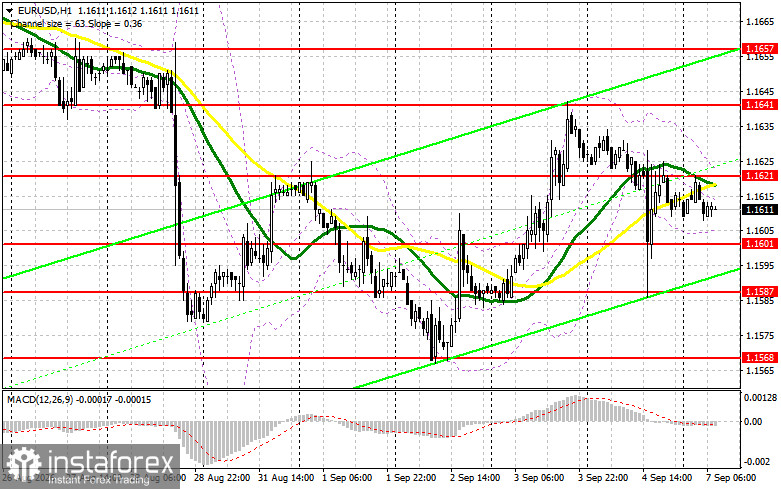
On the hourly chart, I'm looking to buy around 1.1601 and 1.1587 if there's a false breakout or a failed close below those levels. Bulls' task remains a break and hold above 1.1621; a consolidation and breakout beyond that range would open the path to 1.1641 and 1.1657, where selling into rallies for 15–20 pips would be more logical. A new high at 1.1657 would be a reason to speak of a continuing bullish trend that began on September 2. Bearish activity is likely at 1.1621 on a false breakout or at 1.1641 on a failed hold; I will only consider buying pullbacks from 1.1568, targeting the same 15–20 pips.
GBP/USD
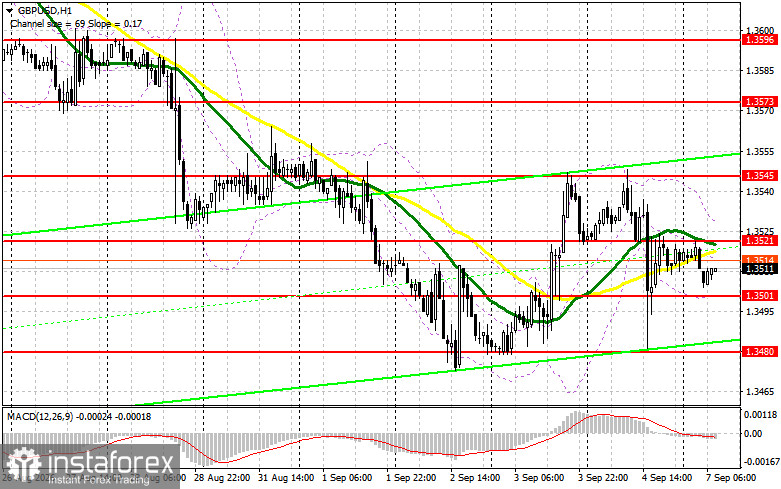
The picture is more complicated. While the euro managed a decent retracement, GBP/USD stalled at 1.3545 and remains trapped in a sideways channel with a lower boundary at 1.3480 and intermediate levels at 1.3501 and 1.3521. On rallies, a false breakout above 1.3521 would be an excuse to sell toward 1.3501; a break and hold below that level would return pressure to 1.3480 (last week's low), and a range breakdown would open the path to 1.3457, where I would expect buying into a 20–25 pip rebound. Long positions from 1.3501 and 1.3480 are justified only if those levels show false breakouts; if bears fail to overcome 1.3521, buyers can push up to 1.3545, where short positions would be triggered on a failed hold or selling into a bounce from 1.3573.
I believe the upside from Friday's dollar rally is limited. The payrolls report has already been priced in; the next decisive impulse comes on September 11. Besides, the ECB meeting this week works against the dollar in EUR/USD. Therefore, in the coming sessions, I expect EUR/USD to consolidate with attempts to climb to the upper end of the range. The pound will likely remain weaker than the euro, and pressure on GBP is likely to persist since the British currency lacks its own fundamental drivers this week.


