
Vea también


 12.06.2026 04:32 AM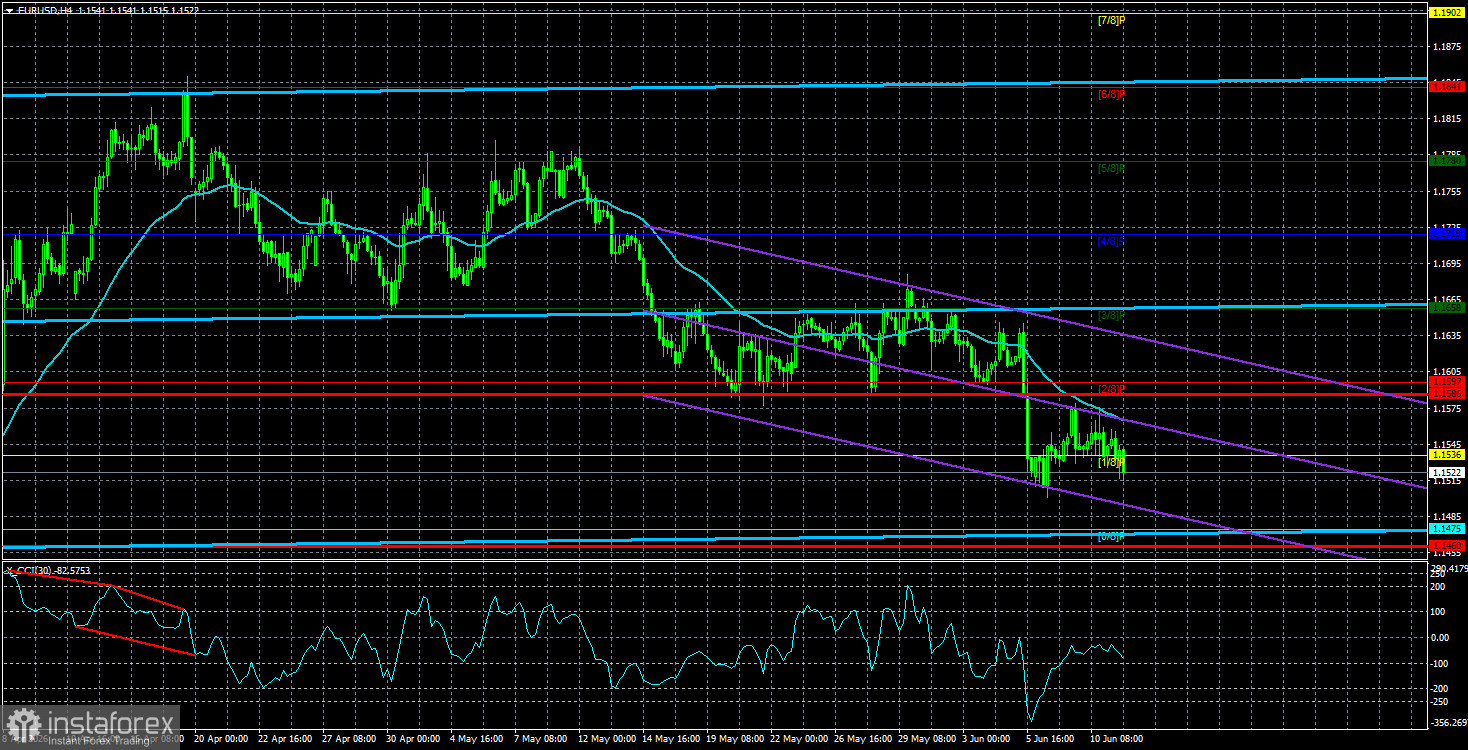
The EUR/USD currency pair traded quite sluggishly on Thursday, despite a truly significant event—the European Central Bank meeting and the first rate hike since 2023. Recall that the ECB was essentially forced to raise refinancing rates to curb the uncontrolled growth of consumer prices triggered by the conflict in the Middle East, which has driven a sharp rise in energy prices. At the same time, neither the Federal Reserve nor the Bank of England is preparing for policy tightening, although they will hold their meetings next week.
On one hand, the market's passivity is easily explained. The ECB's rate hike was known in advance, and the market could have priced it in ahead of time. However, it did not do so, as the euro has rarely shown growth in recent weeks. As a result, the ECB meeting was ignored, just like many other recent fundamental and macroeconomic events.
On the other hand, this is not an ordinary event or an ordinary decision. The ECB has become the first G7 central bank to implement a tightening. Although inflation in the eurozone is lower than, for example, in the US, the US has its own issues. The Fed is in no rush and, according to statements from monetary committee representatives, is in a favorable position to wait and observe the situation. We find it hard to understand what is advantageous about maintaining a position while inflation has nearly doubled in three months, but that is the Fed's stance.
The market remains fully focused on the geopolitical conflict in the Middle East, but as only secondary news or unverified information has been coming in lately, it has not reacted to it at all. Traders are waiting for a clear, public resolution to the conflict. Either Tehran and Washington start a new war, or they sign a peace agreement. Currently, both sides are stuck somewhere between these two options. As there is no specificity on this topic at this time, the market is hesitant to open long or short positions.
So what is left for traders in this situation? In our view, they can only wait for truly significant and resonant events, such as a political crisis in the UK, the resumption of war in the Middle East, a ceasefire between Iran and the US, or a Fed rate hike. All other data are secondary at the moment, and it is unlikely the market will react to them.
On the daily timeframe, it is clear that the EUR/USD pair has been in a sideways channel between 1.1440 and 1.1850 for 10 months, having only briefly exited it once. Thus, while the flat may not be the most classic traders have ever seen, it is nonetheless a flat. The price is currently very close to the lower boundary of the sideways channel, but without geopolitical support, the euro will struggle to start a new upward phase. However, its long-term prospects remain unchanged, with the currency strengthening against the US dollar.
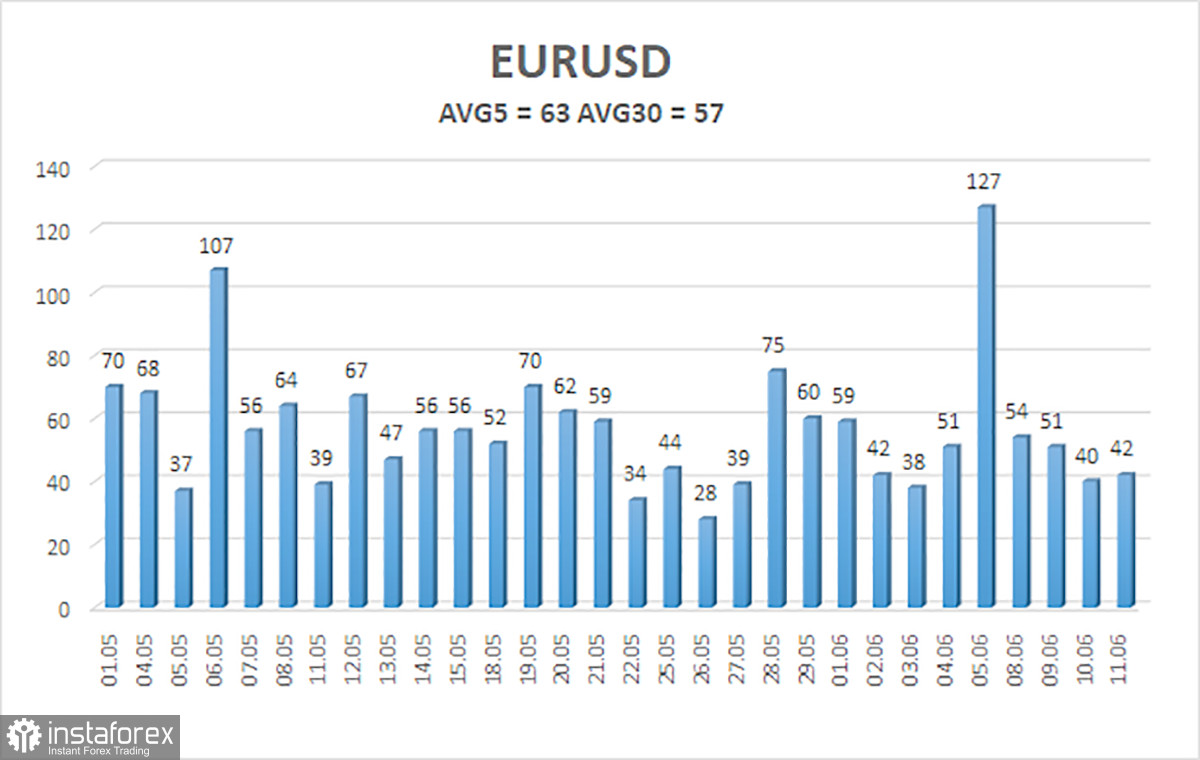
The average volatility of the EUR/USD currency pair over the last five trading days as of June 12 is 63 pips, which is considered "average." We expect the pair to move between 1.1460 and 1.1586 on Friday. The upper channel of the linear regression has shifted upward, indicating a potential upward trend. The CCI indicator has entered the overbought area and formed two bearish divergences, warning of the onset of a downward correction that has not yet completed. On Friday, it entered the oversold area, signaling a possible end to the correction.
The EUR/USD pair continues its downward movement, which is presumably a correction within the global upward trend. The global fundamental background for the dollar remains extremely negative, and only geopolitical factors regularly support it. When the price is below the moving average, short positions can be considered with targets at 1.1475 and 1.1460. Above the moving average line, long positions are relevant with targets at 1.1719 and 1.1780. The market continues to move away from geopolitical factors, but in recent weeks, the dollar has been in demand as hopes for peace in the Middle East have weakened.


