
Vea también


 20.03.2026 09:17 AM
Yesterday, Bitcoin dropped to around the next low of $68,800, then recovered slightly, but the chances of further decline remain quite high. Ethereum also lost ground, failing to return to the $2,000 mark.

Meanwhile, as the market recovers from the clearly hawkish US Federal Reserve meeting, the largest investment bank, Morgan Stanley, submitted an amended S-1 registration statement to the US Securities and Exchange Commission (SEC) regarding its application to create a spot exchange-traded fund (ETF) for Bitcoin.
In the latest application, the second amendment to the ETF creation statement confirms that the Morgan Stanley Bitcoin Trust will be listed on the NYSE Arca under the ticker MSBT. More detailed information about the fund was also added. The basket size is 10,000 shares, with a launch plan that includes an initial basket of 50,000 shares, which is expected to generate about $1 million.
Earlier this month, Morgan Stanley announced that BNY Mellon and Coinbase would act as custodians for the fund's Bitcoin. BNY Mellon will serve as the custodian for cash, the administrator, and the registrar, while Coinbase will be the primary broker.
I would like to remind you that, back in January, Morgan Stanley submitted an application to create a spot Solana ETF alongside the Bitcoin fund. However, the investment bank has not yet amended the application for the Solana trust, indicating a faster progression of the Bitcoin ETF application.
Another major participant is yet another "plus" for the development of the cryptocurrency market.
As for the intraday strategy in the cryptocurrency market, I will continue to act on any significant downturns in Bitcoin and Ethereum, with the expectation of continued bull-market development in the long term, which has not gone anywhere.
As for short-term trading, the strategy and conditions are described below.
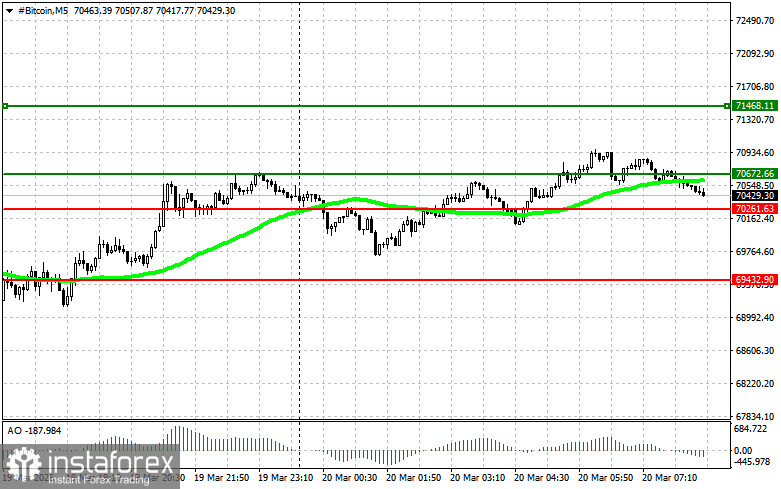
Scenario #1: I will buy Bitcoin today upon reaching the entry point near $70,600, with a target price of $71,500. Around $71,500, I will exit the purchases and sell immediately on the rebound. Before buying on a breakout, ensure the 50-day moving average is below the current price and the Awesome Indicator is above zero.
Scenario #2: Buying Bitcoin can be done from the lower boundary of $70,200 in the absence of market reaction to its breakout back towards levels $70,600 and $71,400.
Scenario #1: I will sell Bitcoin today upon reaching the entry point near $70,200, with a target drop to $69,400. Around $69,400, I will exit the sales and buy immediately on the rebound. Before selling on a breakout, ensure the 50-day moving average is above the current price and the Awesome Indicator is in the zone below zero.
Scenario #2: Selling Bitcoin can be done from the upper boundary of $70,600 in the absence of market reaction to its breakout back towards levels $70,200 and $69,400.
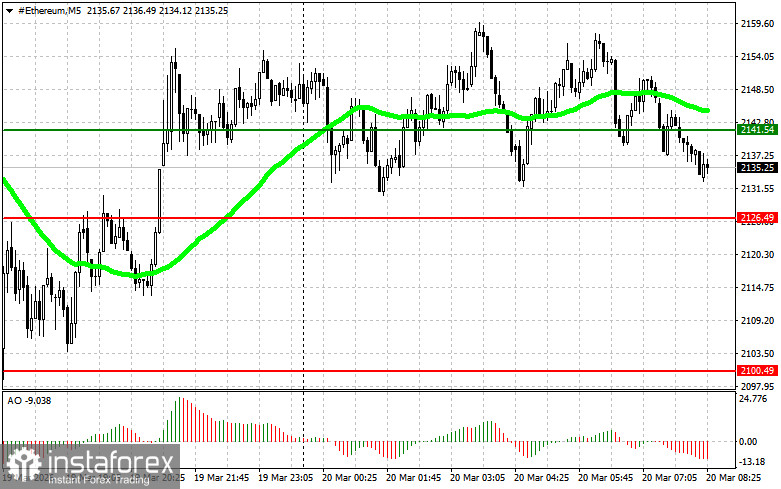
Scenario #1: I will buy Ethereum today upon reaching the entry point near $2,141, with a target price of $2,163. Around $2,163, I will exit the purchases and sell immediately on the rebound. Before buying on a breakout, ensure the 50-day moving average is below the current price and the Awesome Indicator is above zero.
Scenario #2: Buying Ethereum can be done from the lower boundary of $2,126 in the absence of market reaction to its breakout back towards levels $2,141 and $2,163.
Scenario #1: I will sell Ethereum today upon reaching the entry point near $2,126, with a target drop to $2,100. Around $2,100, I will exit the sales and buy immediately on the rebound. Before selling on a breakout, ensure the 50-day moving average is above the current price and the Awesome Indicator is in the zone below zero.
Scenario #2: Selling Ethereum can be done from the upper boundary of $2,141 in the absence of market reaction to its breakout back towards levels $2,126 and $2,100.


