
Veja também


 03.08.2026 03:10 PM
Trade Review and Trading Tips for the Japanese Yen
The first test of the 157.02 level occurred when the MACD indicator had already moved well above the zero line, which limited the pair's upward potential. The second test of 157.02 allowed Sell Scenario No. 2 to play out, resulting in a 40-point decline.
Attention now turns to the release of the U.S. ISM Manufacturing PMI for July, which could set the tone for the U.S. dollar. The index reflects the health of the U.S. manufacturing sector and serves as a leading indicator of economic activity. Its performance directly influences U.S. Treasury yields and expectations for Federal Reserve interest rate policy. Since a revised reading will be published, the market's primary focus will be on the direction of the revision and how the final figure compares with economists' forecasts.
The Japanese yen is likely to react to the report only if the data deviate significantly from expectations. However, the main market theme remains the growing possibility of another Bank of Japan intervention to support the national currency, following the authorities' intervention last week in response to the yen's sharp depreciation. Conversely, weaker-than-expected U.S. data would weaken the dollar and renew demand for the yen.
As for my intraday strategy, I will primarily rely on the implementation of Scenario No. 1 and Scenario No. 2.
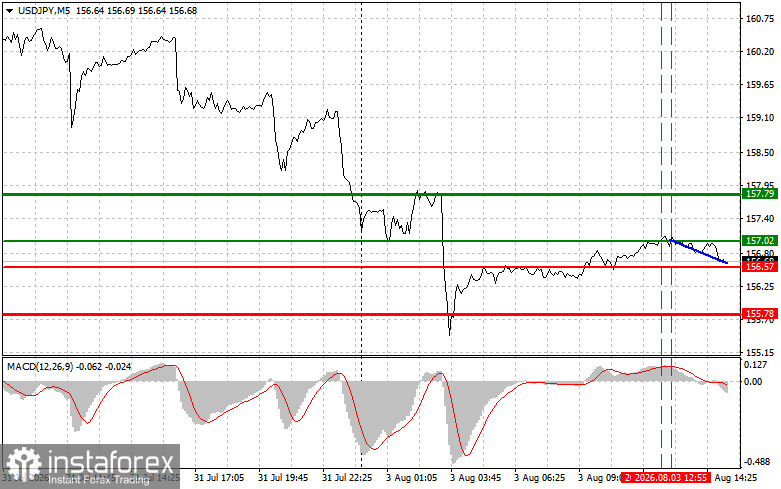
Scenario No. 1: I plan to buy USD/JPY if the price reaches the entry point around 157.02 (the green line on the chart), targeting a move to 157.79 (the thicker green line on the chart). Around 157.79, I plan to close long positions and open short positions, anticipating a 30–35 point pullback. The pair may continue to rise today, although the upside potential appears limited.
Important: Before buying, make sure the MACD indicator is above the zero line and is just beginning to move higher.
Scenario No. 2: I also plan to buy USD/JPY if the 156.57 level is tested twice in succession while the MACD indicator is in oversold territory. This would limit the pair's downward potential and trigger an upward market reversal. In this case, a rise toward 157.02 and 157.79 can be expected.
Scenario No. 1: I plan to sell USD/JPY after the 156.57 level is broken (the red line on the chart), which is expected to trigger a rapid decline in the pair. The key downward target for sellers will be 155.78, where I intend to close short positions and immediately open long positions, anticipating a 20–25 point rebound. Selling pressure on the pair is likely to return if the Bank of Japan intervenes in the currency market.
Important: Before selling, make sure the MACD indicator is below the zero line and is just beginning to move lower.
Scenario No. 2: I also plan to sell USD/JPY if the 157.02 level is tested twice in succession while the MACD indicator is in overbought territory. This would limit the pair's upward potential and trigger a downward market reversal. In this case, a decline toward 156.57 and 155.78 can be expected.
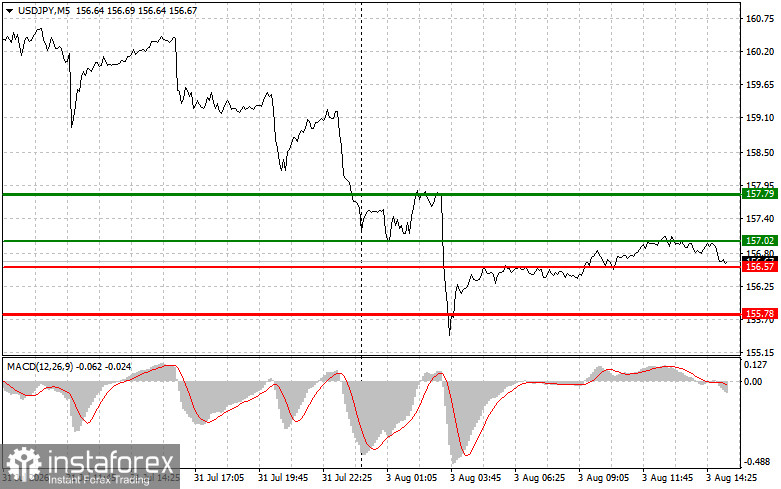
Important: Beginner Forex traders should make market entry decisions with great caution. It is generally best to stay out of the market ahead of major fundamental economic releases to avoid sharp price fluctuations. If you decide to trade during news releases, always use stop-loss orders to minimize potential losses. Trading without stop-loss orders can quickly result in the loss of your entire deposit, especially if you trade large position sizes without proper risk management.
Remember that successful trading requires a clear trading plan, such as the one outlined above. Making spontaneous trading decisions based solely on current market conditions is an inherently losing strategy for an intraday trader.


