
Veja também


 30.04.2026 04:10 AM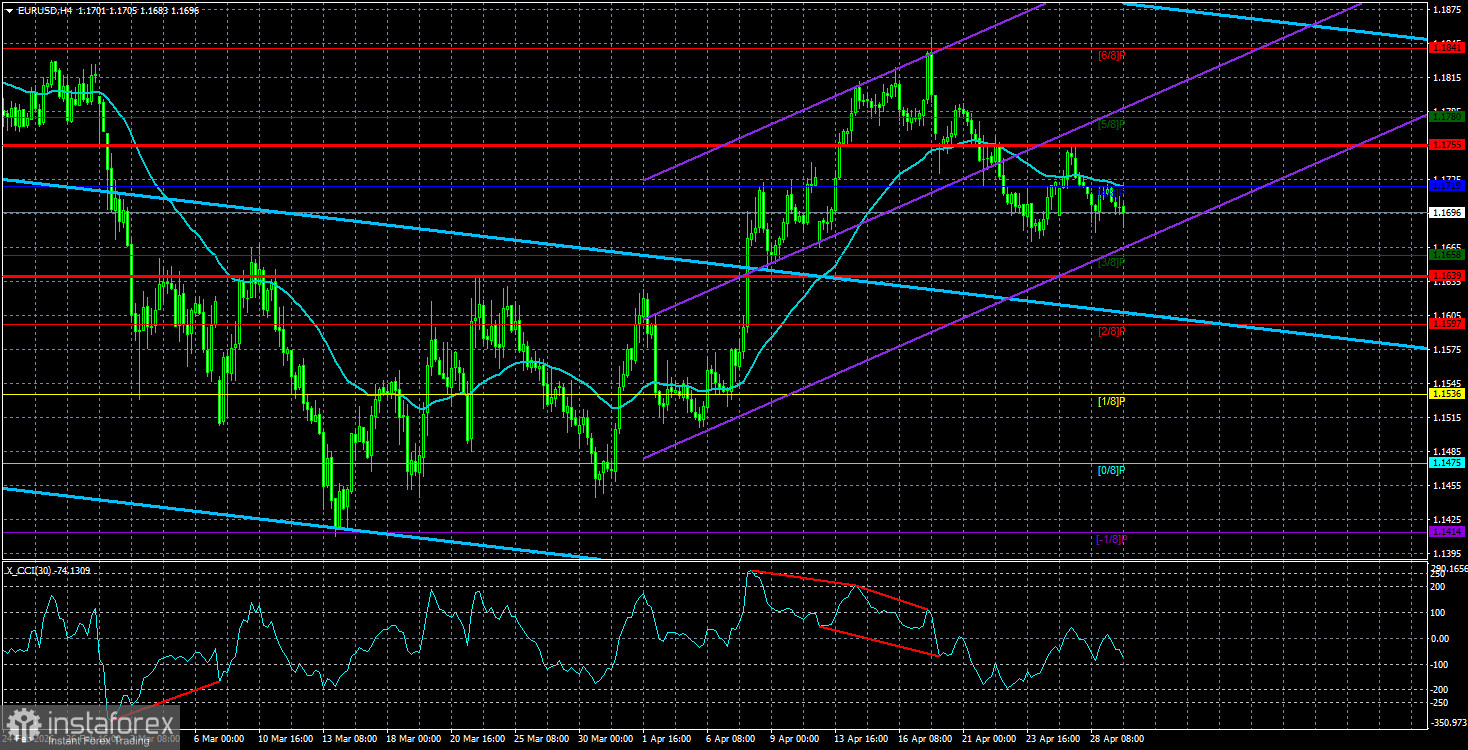
The EUR/USD currency pair traded in the same manner on Wednesday as it did on Monday and Tuesday. We want to clarify that this article will not discuss the results of the FOMC meeting. We still believe that at least 12 hours should pass after the announcement of results and Jerome Powell's speech to properly evaluate both the outcomes and the market's reaction to them. Ideally, it should be about 16-18 hours. It's worth noting that often right after a meeting, the price moves in one direction, only to return to its original position by the next European or American session. Therefore, for now, we will not comment on the Federal Reserve.
There were practically no other events on Wednesday either. Of course, several more or less significant reports were published throughout the day, but it's important to remind that the market has paid little attention to macroeconomic data over the past two months. Volatility has been actively declining in recent weeks, and as of Tuesday morning, it was only 54 pips per day. Thus, what kind of movement could significant reports on inflation in Germany or durable goods orders in the U.S. provoke?
Inflation in Germany has increased, which indicates that the energy crisis triggered by events in the Middle East is just beginning. The Strait of Hormuz remains closed, and the global oil deficit persists and may only increase over time, as many countries are currently using strategic oil and gas reserves, which are not infinite. Sooner or later, these reserves will run out, and accessible oil will become even scarcer. Thus, it does not surprise us that Brent crude oil prices jumped to $118-119 per barrel on Wednesday, when referring to spot prices. The higher oil prices rise, the more expensive all goods and services will become, as oil, gas, and fuel are factored into the cost of nearly everything produced on the planet with the aim of generating profit.
Therefore, while the European Central Bank may not yet be ready to tighten monetary policy, it may raise interest rates at the next meeting. The ECB will simply have no choice but to raise rates; otherwise, inflation will not be contained. Will this have a positive effect on the euro? In our view, yes. The euro remains in a medium-term and long-term upward trend (as clearly seen on the daily and weekly timeframes). Consequently, even without narrowing the divergence on rates between the ECB and the Fed, the euro will rise. In February-March 2026, the U.S. dollar rose not because the American economy started to accelerate or the labor market fully recovered, but because of the geopolitical conflict triggered by Trump in the Middle East. We are confident that the euro would be trading above the $1.20 level right now if it were not for this conflict.
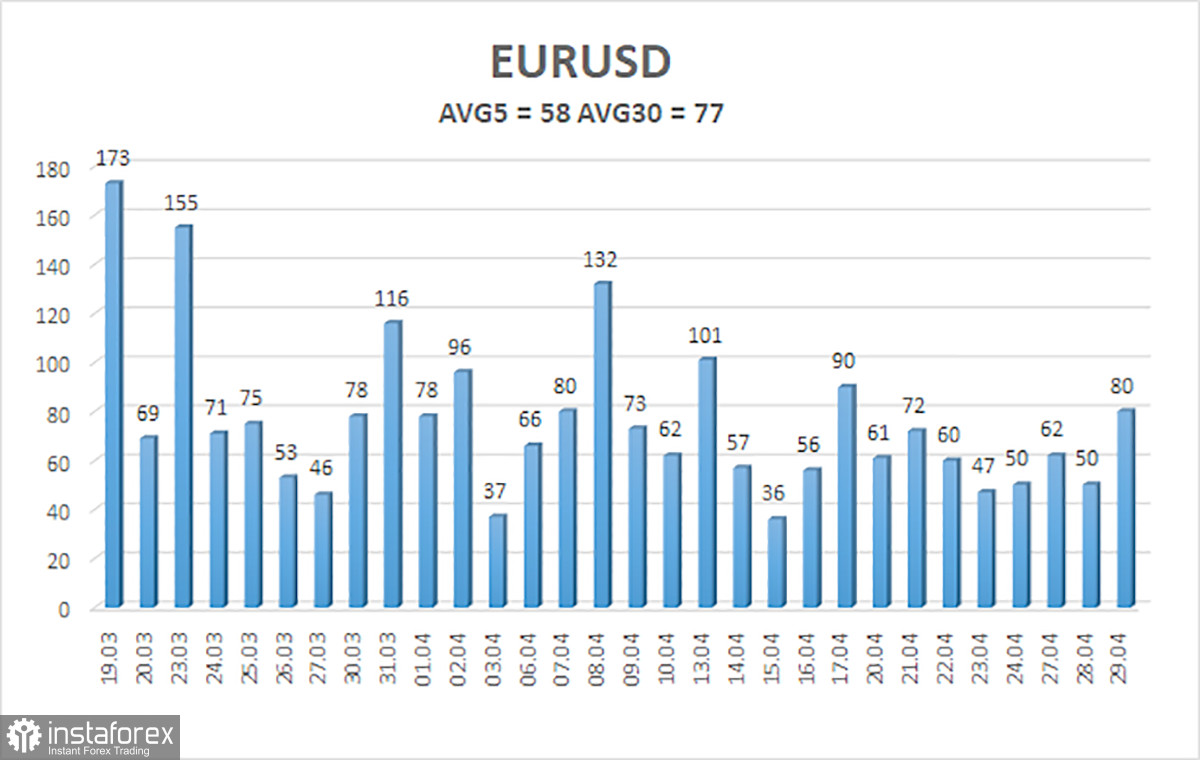
The average volatility of the EUR/USD currency pair over the last five trading days as of April 30 is 58 pips, characterized as "average." On Thursday, we expect the pair to trade between 1.1639 and 1.1755. The upper channel of the linear regression has turned downward, indicating a trend shift to a downward movement. However, the upward trend of 2025 could indeed resume. The CCI indicator has entered the overbought zone and formed a "bearish" divergence, signaling a downward pullback.
S1 – 1.1658
S2 – 1.1597
S3 – 1.1536
R1 – 1.1719
R2 – 1.1780
R3 – 1.1841
The EUR/USD pair maintains an upward trend amid weakening geopolitical influence on market sentiment and easing geopolitical tensions. The global fundamental backdrop for the dollar remains extremely negative, so we still expect the pair to rise in the long term. When the price is below the moving average, short positions can be considered with targets of 1.1658 and 1.1639 on technical grounds. Long positions remain relevant above the moving average line with targets of 1.1780 and 1.1841. The market is distancing itself from the geopolitical factor, and the dollar is losing its only growth driver.
Linear regression channels help to define the current trend. If both are directed in the same way, it means the trend is currently strong;
The moving average line (settings 20,0, smoothed) determines the short-term trend and the direction in which trading should currently be conducted;
Murray levels are target levels for movements and corrections;
Volatility levels (red lines) indicate the probable price channel in which the pair will operate over the next day, based on current volatility readings;
The CCI indicator – its entrance into the oversold area (below -250) or the overbought area (above +250) indicates that a trend reversal in the opposite direction may be approaching.


