
یہ بھی دیکھیں


 28.09.2026 06:11 PM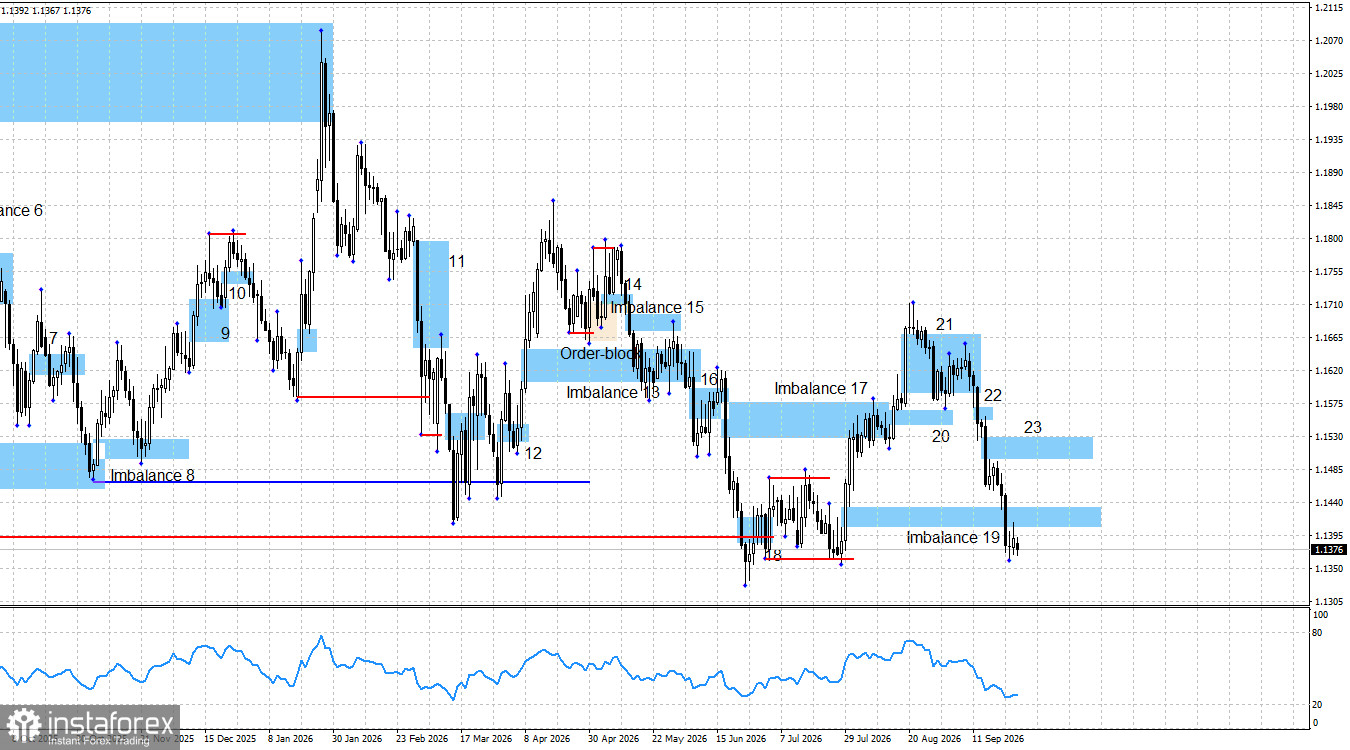
The EUR/USD pair had been falling for eleven consecutive days. During this time, the euro lost 280 points. Only in the last few days has the euro managed to avoid another decline, while the bears have slightly moderated their pressure. The euro's losing streak began three weeks ago as the market prepared for an FOMC rate hike. Since then, the market has continued buying the dollar on the basis of the Fed's hawkish monetary policy stance, which is regularly confirmed by FOMC members. Interestingly, many Fed officials openly state that further monetary policy tightening is necessary, but at the same time they do not say how much the interest rate could be raised, while the latest dot plot showed that another 0.25% rate hike should be expected. Has the dollar appreciated too much for a single rate hike? The dollar is currently rising as if the Fed had shifted from completely neutral rhetoric to an ultra-hawkish stance. But in reality, the process of monetary policy easing could begin in 2027. If the Fed plans one more tightening move and all 12 voting FOMC members say so in interviews, that is the same as if the Fed raised the rate once and nobody said anything about it. In other words, there is no reason to expect more than one rate hike.
Nothing can stop the decline of the euro. Neither tighter ECB policy, nor favorable economic data from the European Union, nor the chart setup and bullish patterns can do so. Imbalance 19 has been invalidated, so the euro now has every chance of falling below the psychological level of $1.10. And bullish imbalance 19 is now not simply invalidated; it has turned into a bearish inverted imbalance. It is now a bearish pattern alongside imbalance 23. Thus, traders currently have two zones of interest for short trades. The only factor supporting the bulls is the proximity of the last two swing lows, from which liquidity could be taken, potentially triggering a bullish advance.
Last week, the FOMC indicated its readiness to continue tightening policy, which was enough to trigger a large-scale bearish advance. Even after the Fed's monetary policy tightening in September and a possible tightening in November or December, I do not see what other reasons could make traders continue buying the U.S. currency. The dollar has indeed performed very strongly in recent weeks, but what factors have supported it during this period? FOMC monetary policy tightening and nothing else?
Overall, in my view, the information backdrop continues to favor the bulls. Despite the Fed's more hawkish monetary policy stance, this is not the only factor on which currency exchange rates are based. I would like to remind you that U.S. Treasury yields are reaching record highs, creating enormous pressure on the budget; the U.S. economy has been slowing in recent quarters; Donald Trump resumed his campaign of trade and non-trade demands against many countries around the world in 2026; and the U.S. stock market continues to raise serious concerns because of uncontrolled credit-fueled investment in technology companies involved in AI development.
The current chart setup indicates that the bearish momentum is continuing. Despite the highly contradictory price movement over the past three weeks, traders now have at least two zones of interest for short trades. The bulls can only hope for the lows of July 28 and June 24, from which liquidity could be taken.
There was no economic news on Monday. Thus, traders took another day off and are considering which direction to move in next.
There are still numerous reasons for the bulls to attack in 2026. Structurally and globally, Trump's policies, which led to a significant decline in the dollar last year, have not changed. At present, I do not see any significant factors supporting the U.S. currency despite the FOMC's hawkish stance. Geopolitical factors, which supported demand for the U.S. currency during most of the first half of 2026, are no longer doing so.
On September 29, the economic calendar contains three entries, none of which I consider significant. The impact of the economic backdrop on market sentiment on Tuesday will be weak or nonexistent.
In my view, the pair remains in the process of forming a bullish trend that has taken a one-year pause. The information backdrop changed sharply in favor of the bears six months ago, but the trend itself cannot be considered canceled or complete. In the long term, I would say that the pair is trading in a range. A range does not invalidate the broader bullish trend. Thus, the bulls may resume their advance in 2026, but their only opportunities now are the lows at 1.1354 and 1.1325, from which liquidity could be taken. The bears currently have imbalances 19 and 23, from which new short trades can be opened. However, in my view, the current decline is dangerous for traders because it lacks clear and sufficient justification. The dollar could well fall even below the 1.10 level, but the rationale for such a decline is too contradictory.


