
یہ بھی دیکھیں


 13.05.2026 11:15 AM
Yesterday, the US dollar rose following the news that the US consumer price index for April delivered an unpleasant surprise to markets: inflation accelerated to its highest level in nearly two years. For the first time in three years, the CPI outpaced wage growth. The report, released on Tuesday, highlighted concerns about the persistence of inflationary pressure in the American economy.

Headline CPI rose 0.6% month?on?month — exactly in line with forecasts. The annual CPI reached 3.8%, the highest since May 2023 and, for the first time in three years, exceeding wage growth. This means real incomes for Americans have notably fallen.
The core index, excluding food and energy, rose 0.4% for the month — slightly above the consensus forecast. Year?on?year core inflation was 2.8% — the largest increase since September last year.
Several key components stand out among those pushing inflation higher. Energy remains the main driver of price growth: in April it jumped 3.8% month?on?month, after a 10.9% surge in March. Gasoline prices rose 5.4%. Importantly, gasoline price acceleration is a key factor in American consumer confidence in their president and his policies. Airfares surged sharply — up 2.8% month?on?month and about 20.7% year?on?year — one of the most notable spikes in the services sector.
The report also says that housing prices made a distorted contribution to core inflation due to a statistical anomaly. At the end of last year, during the government shutdown, housing market data were not collected and statisticians recorded a zero price change. This led to an overstatement of the April figures: according to Natixis, owner?equivalent rent added 0.17 percentage points to the core measure. Housing prices rose the most since 2024.
The main threat to the US economy now is the so?called second?wave effect: when persistently high headline inflation influences inflation expectations among consumers and businesses. In that case, containing price pressure will become significantly harder, placing increasing strain on the Federal Reserve. This scenario has prompted market participants to revise Fed rate forecasts — the probability of a hike by year?end has already exceeded 40%.
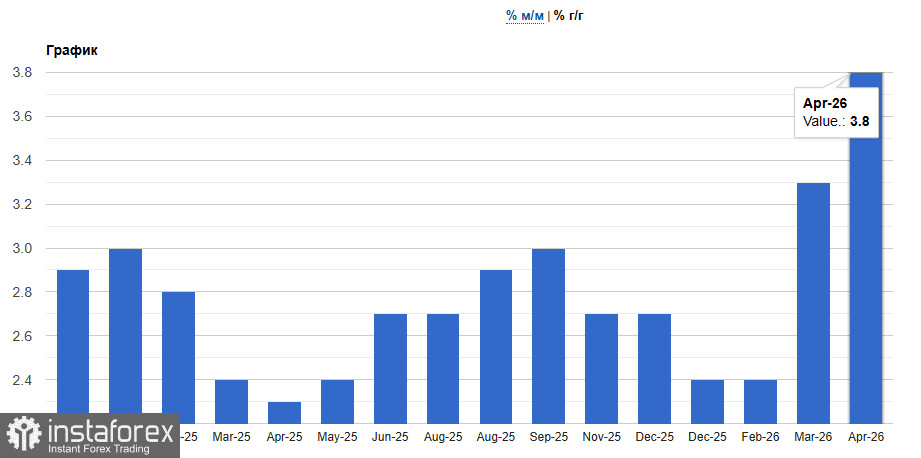
As noted above, the US dollar responded with a rise because the April CPI report clearly showed that inflation in the US remains stubbornly high and increasingly multi?faceted — energy, housing, and services. If the situation in the Middle East does not stabilize in the near term, it will become even harder for the Fed to cope with rising price pressure.
Technical outlook for EUR/USD
Buyers now need to focus on taking the 1.1750 level. Only that would allow targeting a test of 1.1795. From there, the pair can move to 1.1825, though doing so without support from major players will be difficult. The furthest target is 1.1850. On the downside, I expect serious buying interest only around 1.1725. If there is no one there, it would be better to wait for a new low at 1.1700 or open long positions from 1.1675.
Technical outlook for GBP/USD
Pound buyers need to take the nearest resistance at 1.3550. Only that would allow targeting 1.3585, above which a breakout will be quite difficult. The furthest target is 1.3620. On the downside, bears will try to take control of 1.3525. If they succeed, a break of the range would deal a serious blow to bulls and push GBP/USD to a low of 1.3500 with a prospect of moving to 1.3480.


