
Lihat juga


 28.09.2026 11:21 AM
The wave count on the four-hour chart for EUR/USD is becoming more complex. There is still no reason to consider the upward trend segment (lower chart), which began in January last year, invalidated. On the contrary, we saw a complete A-B-C corrective structure, which may have been completed. However, recent events related to the Federal Reserve and its policy have once again affected the current wave count, making it more complex. I would like to remind you that the news background and wave count often conflict with each other, making adjustments necessary.
The wave count has now transformed into a more complex structure. Wave C has taken a three-wave form, while the next wave is identified as wave D. The entire trend segment that began on January 27 may have taken the five-wave corrective form of A-B-C-D-E. If this assumption is correct, wave D is complete, and on August 21, EUR/USD entered the phase of forming wave E, whose low should be below the low of wave C at 1.1325. The pair is only a short distance from this level, and below it, the assumed wave E may complete its formation at any time.
New Labor Market and Inflation Reports
The EUR/USD pair rose by 10 basis points on Friday, so it can be stated with confidence that the attempt to complete the downward wave or wave sequence ended unsuccessfully. At the same time, the market appears to be returning to a wait-and-see mode ahead of important economic data. A new month begins this week, so the market will be awaiting reports on the US labor market, unemployment, inflation, and business activity. I would like to remind you that the Federal Reserve began a cycle of monetary policy tightening after determining that the labor market and economy were in good condition, allowing it to raise interest rates. This Friday, we will find out whether this assessment remains valid.
In my view, the US labor market remains in a weakened state. The Federal Reserve has stated that it is prepared to continue tightening monetary policy under the current labor-market conditions, but what if those conditions deteriorate? What if the August Nonfarm Payrolls report was an exception rather than the rule? I would like to remind you that the previous four months had produced Nonfarm Payrolls figures that were extremely weak. Therefore, in my view, one month is not sufficient to draw conclusions. Moreover, FOMC members themselves have repeatedly stated that the assessment should be based not on a single month but on the overall trend. Consequently, it is difficult to describe the US labor market as strong.
As for inflation, the PCE Price Index, which receives particular attention from the Federal Reserve, will most likely accelerate in August, but this data can already be considered outdated at the beginning of October. In my view, the overall inflation rate remains a more important and more current indicator. US economic growth in the second quarter may slow to 1.5–1.6%.
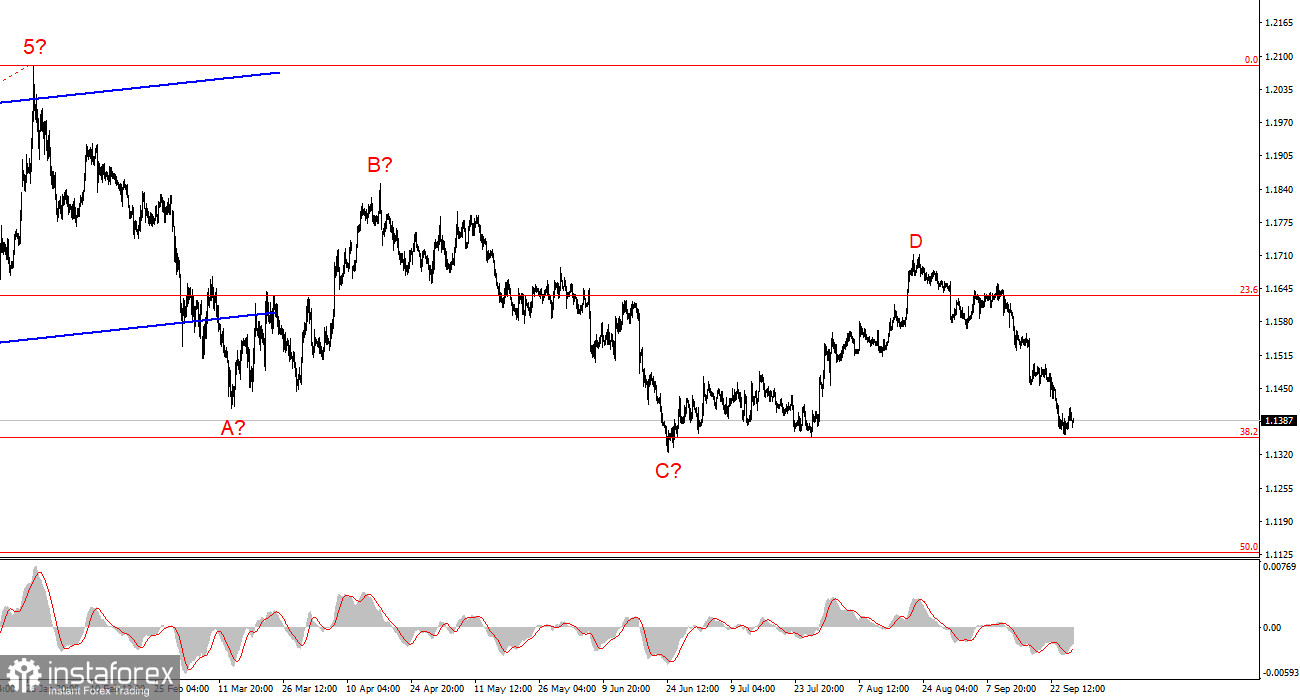
Based on my EUR/USD analysis, I conclude that the pair remains within the global corrective trend segment A-B-C-D-E. If this assumption is correct, the decline in prices will continue toward targets below the low of wave C at 1.1325. I previously considered this scenario an alternative, and if it had not been for the Federal Reserve meeting, it would have remained a secondary scenario. However, the Federal Reserve delivered a surprise, leaving the market with no other options but another wave of US dollar buying. Nevertheless, buying has continued for several weeks, even though the dollar has no new supporting factors. I would not open short positions against such a news background and, on the contrary, would prepare for a reversal.
On the higher timeframe, an upward trend segment can be seen, followed by the formation of an A-B-C corrective structure. This structure could take a five-wave form, but at the current stage I consider it complete. If this is the case, a new impulsive upward trend segment has begun to form.
Key Principles of My Analysis:


