यह भी देखें


 03.07.2026 10:12 AM
Yesterday, the U.S. dollar continued to decline against the euro, the pound, and other risk-sensitive assets after June's U.S. economic data delivered an unexpected surprise, triggering a wave of volatility across global financial markets.
News of a sharp slowdown in hiring, despite a decline in the unemployment rate to 4.2%, became the catalyst for a rapid sell-off in the U.S. dollar. Traders, who had become accustomed to the dollar's strength, interpreted this information as a signal to reassess their strategies, which was immediately reflected in the currency's exchange rate. At the same time, the euro and other risk-sensitive assets posted strong gains. This shift in currency market dynamics could have far-reaching implications, especially as the Federal Reserve has recently adopted a more dovish stance than before.
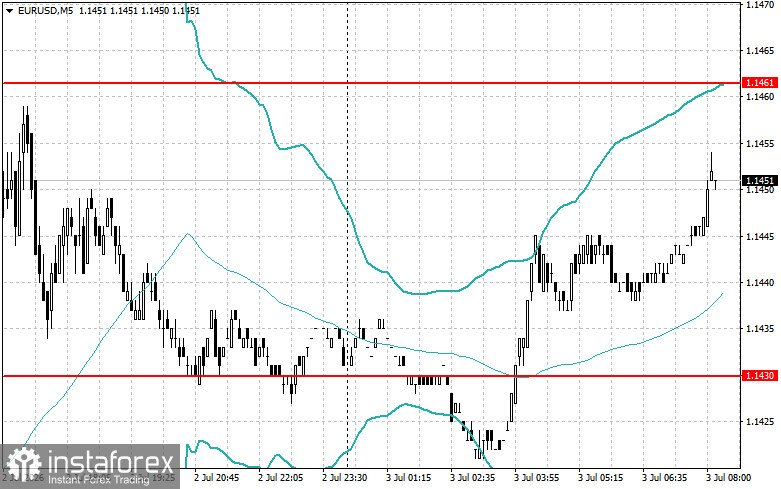
During the first half of today's session, key economic data capable of significantly influencing the euro will be released. Traders will focus on the Eurozone Services PMI, a leading indicator that is highly sensitive to changes in business and consumer sentiment and provides insight into the health of one of the region's most important economic sectors. At the same time, the Composite PMI will also be published. This broad indicator combines data from both the manufacturing and services sectors, providing a more comprehensive picture of overall economic conditions. Analyzing these figures will help market participants better assess the trajectory of economic growth and the potential challenges facing both the eurozone economy and the euro.
The highlight of today's session will be a speech by European Central Bank President Christine Lagarde. Amid heightened economic uncertainty and ongoing discussions about monetary policy, her remarks will carry particular significance.
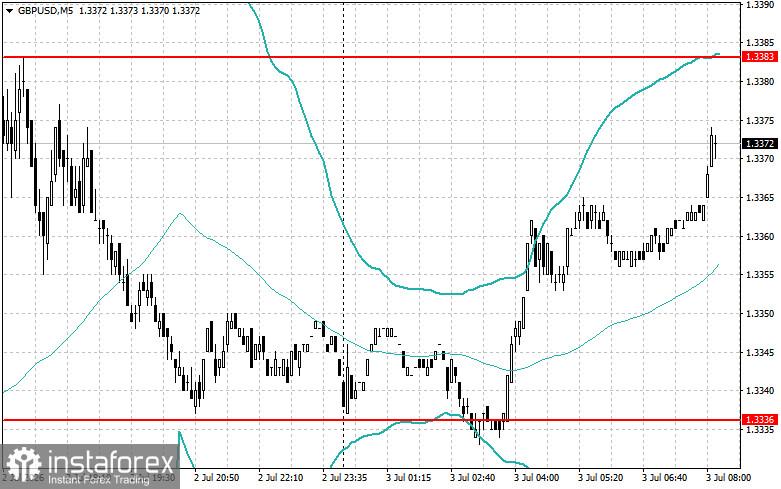
As for the pound, traders will focus during the first half of the day on the release of the same key macroeconomic indicators as in the eurozone. The publication of the Services PMI and the Composite PMI will serve as important gauges of the current state of the UK economy. The day's key event will then be a speech by Bank of England Governor Andrew Bailey. His remarks will be closely analyzed for signals regarding the future direction of monetary policy. His recent dovish comments weighed on the pound, so today's speech will be watched closely. Amid persistent inflationary pressures and uncertainty in the global economy, every word from the head of the central bank could have significant market implications.
If the data matches economists' expectations, it is preferable to follow the Mean Reversion strategy. If the data is significantly stronger or weaker than expected, the Momentum strategy is likely to be more appropriate.
Momentum Strategy (Breakout Trading)
Mean Reversion Strategy (Fade the False Breakout)