
यह भी देखें


 24.03.2026 02:56 PM
Trade Analysis and Tips for Trading the Japanese Yen
The test of the 158.58 level occurred when the MACD indicator had just begun moving downward from the zero mark, confirming a correct entry point for selling the dollar. As a result, the pair declined by more than 20 points.
Next, market participants are awaiting a series of important statistical releases that will shed light on the condition of key sectors of the U.S. economy. A central focus will be on the PMI business activity indices. Analyzing both PMI indices together, along with the expected composite indicator that combines data from manufacturing and services, will provide a comprehensive view of the current business climate. Values above 50 traditionally indicate economic expansion, while readings below that level point to a slowdown. In the event of a sharp decline in the indicators due to a rapid rise in energy prices, the dollar may weaken against the yen, leading to a drop in USD/JPY. Strong data, on the other hand, will quickly return the pair to growth.
Additional insights into the manufacturing sector will come from the report on the corresponding index of the Federal Reserve Bank of Richmond. Although this regional indicator is less significant than nationwide data, it can provide valuable information about local trends and early signals from one of the most important industrial regions. As noted above, unexpected changes in PMI and the regional Fed index may cause significant volatility in the foreign exchange market.
As for the intraday strategy, I will mainly rely on the implementation of scenarios No. 1 and No. 2.
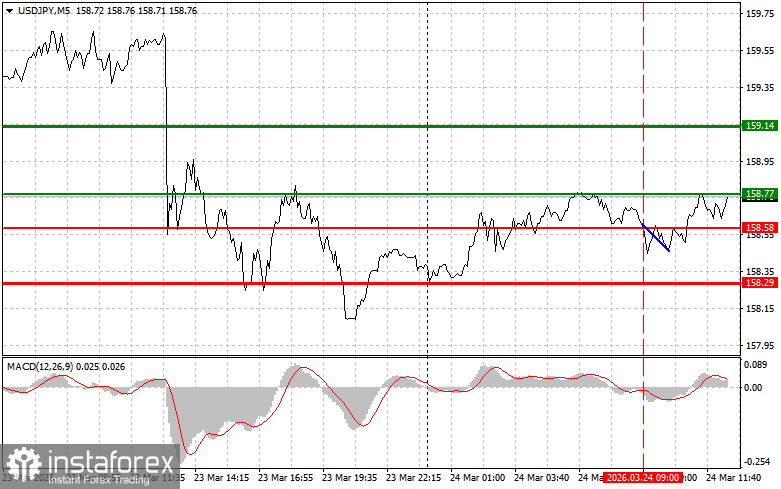
Buy Signal
Scenario No. 1: Today, I plan to buy USD/JPY when the price reaches the entry point around 158.79 (green line on the chart), with a target of 159.14 (thicker green line on the chart). Around 159.14, I will exit long positions and open short positions in the opposite direction (expecting a move of 30–35 points). Growth in the pair can be expected today in case of strong U.S. data.Important! Before buying, make sure that the MACD indicator is above the zero line and just beginning to rise from it.
Scenario No. 2: I also plan to buy USD/JPY today in the case of two consecutive tests of the 158.62 level when the MACD indicator is in the oversold zone. This will limit the pair's downward potential and lead to an upward market reversal. Growth toward the opposite levels of 158.79 and 159.14 can be expected.
Sell Signal
Scenario No. 1: Today, I plan to sell USD/JPY after the price breaks the 158.62 level (red line on the chart), which will lead to a rapid decline in the pair. The key target for sellers will be 158.29, where I plan to exit short positions and immediately open long positions in the opposite direction (expecting a 20–25 point move). Pressure on the pair may return at any moment.Important! Before selling, make sure that the MACD indicator is below the zero line and just beginning to decline from it.
Scenario No. 2: I also plan to sell USD/JPY today in the case of two consecutive tests of the 158.79 level when the MACD indicator is in the overbought zone. This will limit the pair's upward potential and lead to a downward market reversal. A decline toward the opposite levels of 158.62 and 158.29 can be expected.
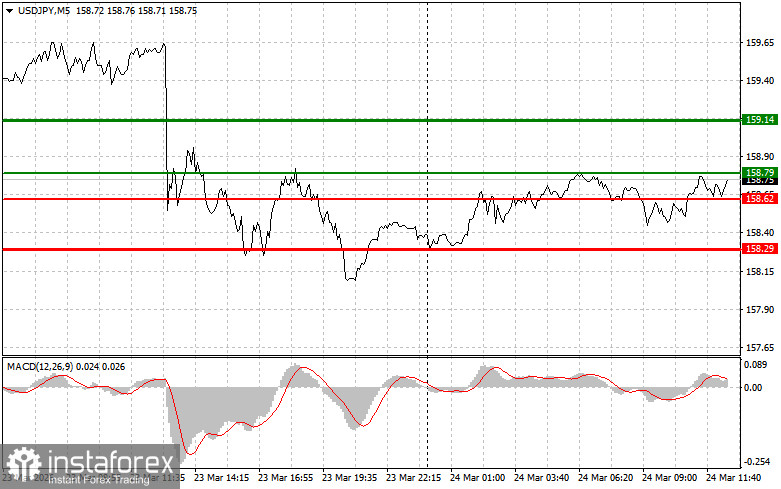
What's on the Chart
Important
Beginner Forex traders must make market entry decisions very carefully. Before major fundamental reports are released, it is best to stay out of the market to avoid sharp price fluctuations. If you decide to trade during news releases, always place stop-loss orders to minimize losses. Without stop-loss orders, you can quickly lose your entire deposit, especially if you do not use proper money management and trade large volumes.
And remember, successful trading requires a clear trading plan, like the one presented above. Spontaneous decision-making based on current market conditions is an inherently losing strategy for an intraday trader.

