
See also


 26.08.2026 05:04 AM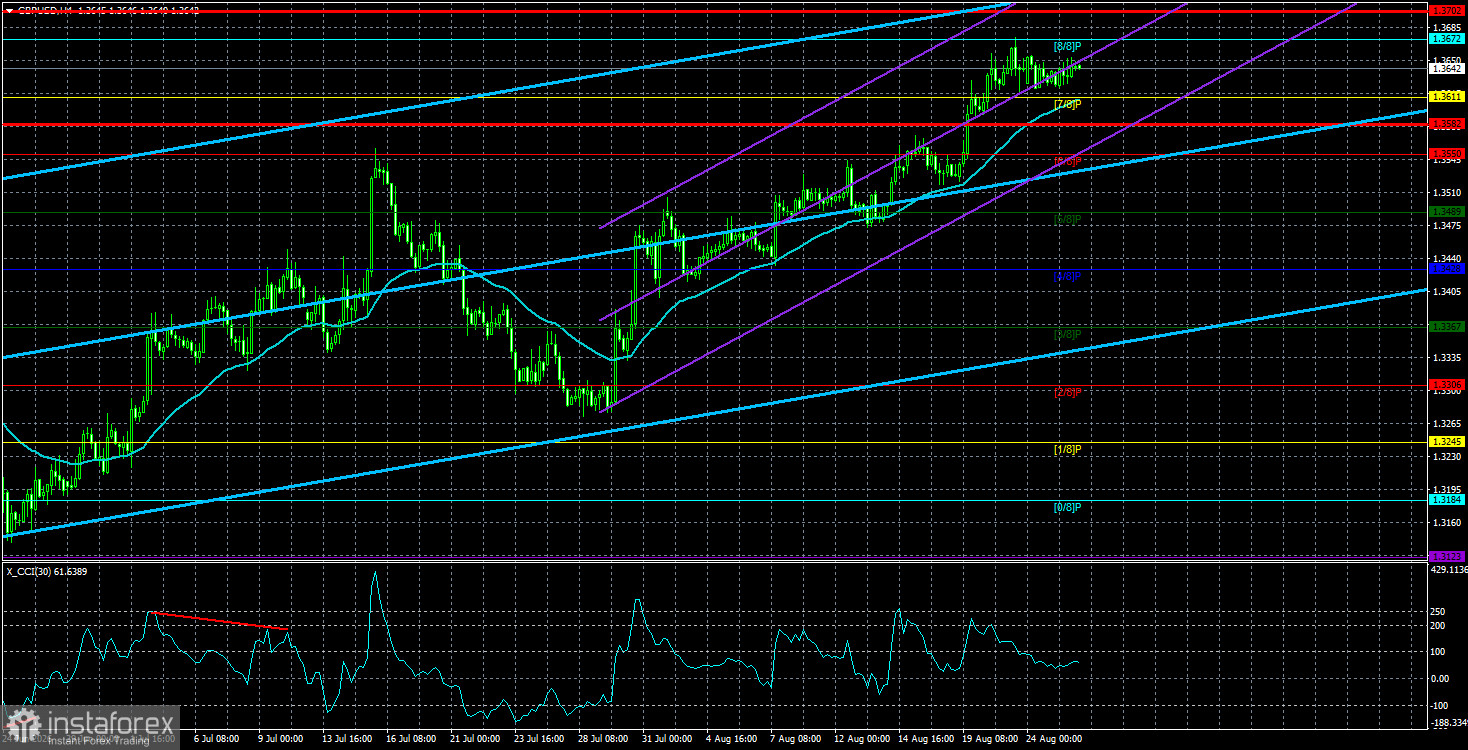
The GBP/USD currency pair was nearly motionless throughout Tuesday, as traders had little to react to. In the current situation, the focus remains on upcoming events that could impact the currency market. Notably, last week, of all the macroeconomic reports and events, only the U.S. Treasury's decision truly influenced trader sentiment. On that day, the GBP/USD pair demonstrated volatility exceeding 100 pips, marking the first instance since July 31. Over the past eighteen trading days, daily volatility exceeded 100 pips only once.
Therefore, concerning the current week, we hold no illusions. We will likely see normal movement only on Friday, unless another "black swan" event occurs, as last Wednesday. On Friday, the new Federal Reserve Chair, Kevin Warsh, will speak at the symposium in Jackson Hole, and the annual Non-Farm Payroll report will be published, which previously showed a decrease of 911,000 jobs (!!!). Thus, traders have the right to expect a significant value this time as well. Now, let's ask ourselves who believes that the total number of Non-Farm Payrolls will be revised upward?
Now, regarding Warsh's speech. The Fed Chair is currently under relentless criticism. The markets are puzzled: if inflation is high and needs to be battled, why isn't the Fed taking any "hawkish" measures? If inflation is not a top priority for the central bank, why does Warsh not publicly admit to abandoning plans for tightening monetary policy? Thus, on Friday, all market attention will be on the Fed Chair for answers to pressing questions.
However, it is unlikely that the market will receive them. From his very first speech, Warsh has taken the position of "saying what the markets want to hear." In other words, he cannot publicly deny the problem of high inflation, as this would make consumers realize a simple truth—that the Fed cannot or does not want to combat inflation. Trust in the central bank would collapse to the same level as trust in the U.S. president. Therefore, Warsh will never admit that tightening policy is impossible at this time. However, he also cannot deny the weakness in the labor market and the slowdown in the American economy, which should rightly call for a loosening of monetary policy.
Therefore, we believe that the Fed will continue to keep the key rate unchanged and will not escalate the situation. Interest rates cannot be raised because of the labor market and the economy. They cannot be lowered because of inflation. It is difficult to say how satisfied the market will be with such answers, but they will clearly not instill confidence in the U.S. dollar. Thus, we continue to believe that the maximum the dollar can hope for now is a correction, while the global bullish trend of 2022 is close to resuming.
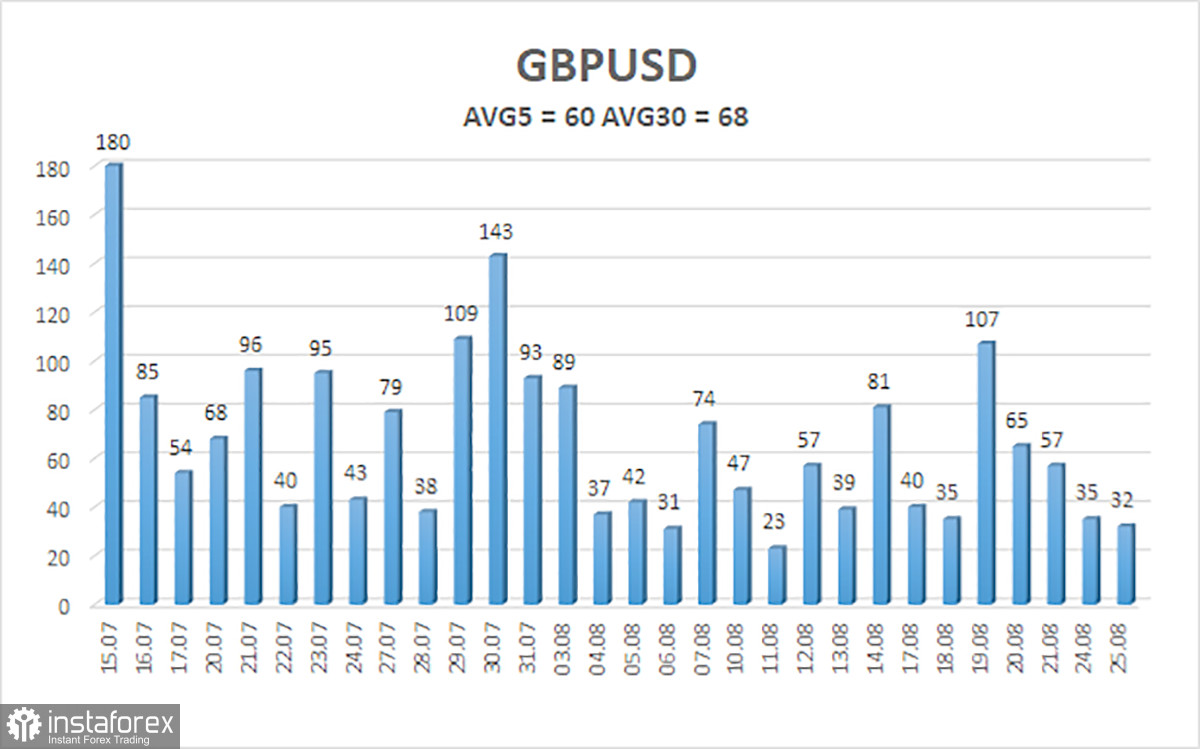
The average volatility of the GBP/USD pair over the last 5 trading days is 60 pips. For the pound/dollar pair, this value is considered "average." On Wednesday, August 26, we expect movement within a range bounded by 1.3582 and 1.3702. The upper linear regression channel has turned upward, indicating an upward trend. The CCI indicator has entered the overbought area for the third time, signaling a potential correction.
S1 – 1.3611
S2 – 1.3550
S3 – 1.3489
R1 – 1.3672
R2 – 1.3733
R3 – 1.3794
The GBP/USD currency pair maintains an upward trend. Trump's policies will continue to exert pressure on the U.S. economy, so we do not expect long-term growth in the U.S. dollar. The year 2026 is shaping up to be highly positive for the dollar due to geopolitical factors, but every fairy tale comes to an end. On the weekly timeframe, a flat pattern persists between 1.3150 and 1.3780 within a four-year upward trend, supporting expectations of continued growth in the British currency in the medium term.
Long positions with targets of 1.3672 and 1.3702 can be considered when the price is above the moving average. If the price is below the moving average, bearish trading can be pursued with targets at 1.3550 and 1.3489.


