
See also


 18.06.2026 06:51 PM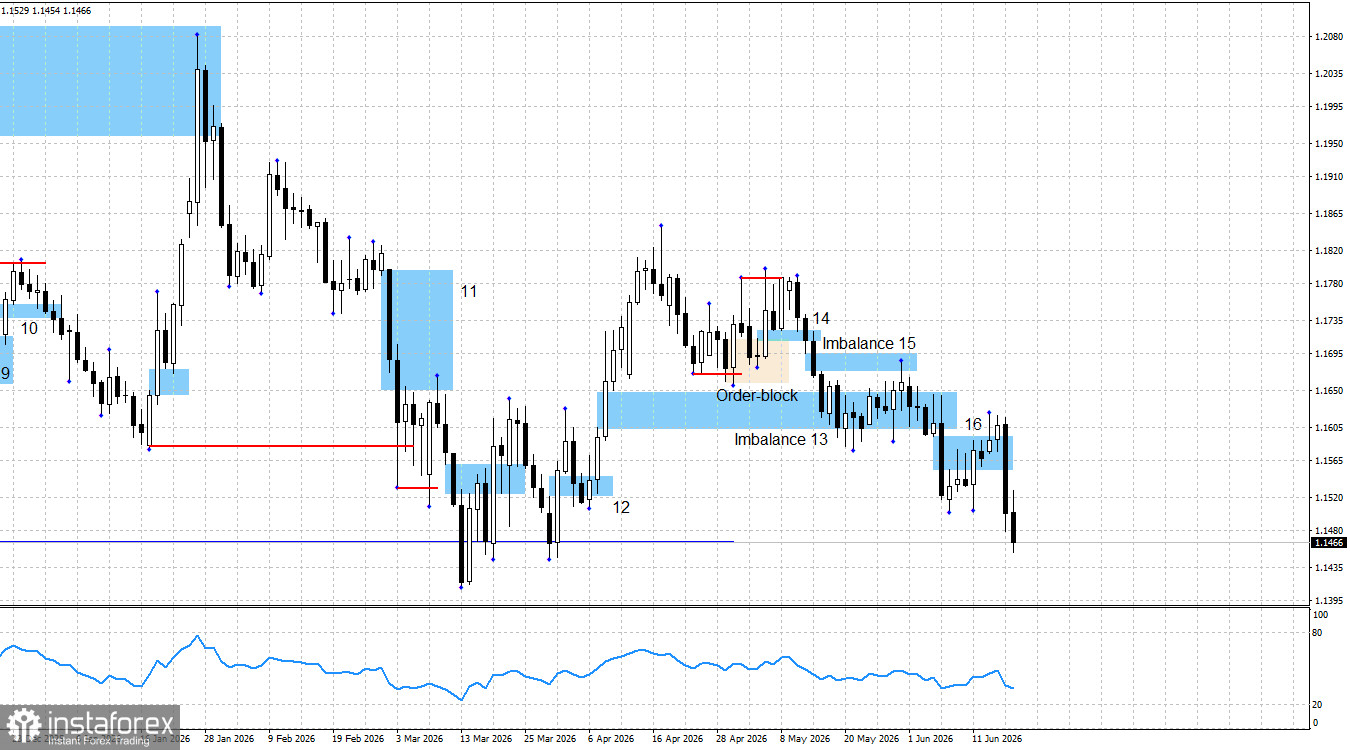
The EUR/USD pair has declined by 200 points over the past two trading days. Yesterday evening, the results of the fourth FOMC meeting of 2026 were announced, delivering a very positive surprise for the U.S. dollar. Traders had initially assumed that the Fed's stance might become more hawkish due to elevated inflation. In reality, however, the shift proved to be even more aggressive.
In recent weeks, the market had largely priced in no more than one round of monetary tightening before year-end. However, after the release of the updated dot plot, it became clear that there could be two or even three rate hikes. Of course, it is still difficult to determine exactly how many times the Fed may raise rates before the end of the year, as only four meetings remain. Nevertheless, the fact that half of FOMC policymakers support at least one additional rate hike suggests that the Fed's hawkish stance could become even stronger over the next six weeks.
During the press conference, Kevin Warsh expressed concern that inflation has remained above the Fed's target for five years, effectively dispelling market fears that he would become a "puppet of the White House." Warsh adopted a firm stance and came close to promising a return of inflation to the 2% target in the near future. As a result, the base-case scenario for the remainder of the year now points to two rate hikes, which traders have been pricing in for a second consecutive day.
Geopolitics has definitively moved into the background this week. According to some reports, Tehran and Washington have already signed a memorandum of understanding, extended the ceasefire for 60 days, and begun work on reopening the Strait of Hormuz. Nuclear negotiations are also expected to begin soon.
However, the market did not deliver the anticipated decline in the dollar despite easing geopolitical tensions. Nor did the euro benefit from the ECB's monetary tightening. Bears continue to maintain control despite the broader news and geopolitical backdrop. Under these circumstances, traders should wait for the current bearish phase to run its course. The broader bullish trend remains intact.
There are currently no active trading patterns. Bearish imbalance 16 ultimately held, but price moved above it, so I would not interpret it as a valid sell signal. In my view, if not for the Fed meeting, the pair would not have experienced such a sharp decline. In fact, imbalance 16 was close to being invalidated.
Nevertheless, the current technical picture points to the continuation of the bearish impulse that began on April 17. In the near term, bulls can only rely on liquidity grabs around the lows of March 30, March 19, March 13, and August 1 of last year.
I would once again emphasize that the entire rally in the U.S. dollar between January and March was driven primarily by geopolitical factors. As soon as the United States and Iran agreed to a ceasefire, bears immediately retreated, and bulls dominated market activity for more than a month.
At present, the agreement has been signed, and the market has been preparing for another advance in EUR/USD. However, strong support for the dollar came from the Fed's shift toward a more hawkish stance. Despite the ongoing appreciation of the dollar, I continue to expect the current bearish impulse to end and the broader bullish trend to resume.
There was no significant economic data released on Thursday, and market attention remained focused on the Fed and the Bank of England. Consequently, traders still had plenty of information from Wednesday's events to process.
No notable economic reports were released in the Eurozone on Thursday, while the ECB's decision to raise rates last week was largely ignored by the market.
Bulls still have numerous reasons to remain active in 2026, and even the conflict in the Middle East has not reduced their number. Structurally and fundamentally, the policies implemented by Trump—which contributed to a significant decline in the dollar last year—have not changed.
In the coming months, the U.S. currency may occasionally strengthen amid periods of risk aversion, but this factor would require a continuous escalation of tensions in the Middle East. This week's dollar rally was driven primarily by the FOMC's readiness to tighten monetary policy further in 2026.
News Calendar for the United States and the Eurozone:
June 19: The economic calendar contains no significant events. Therefore, the impact of the economic backdrop on market sentiment on Friday is expected to be minimal.
EUR/USD Forecast and Trading Recommendations:
In my view, the pair remains in the process of forming a bullish trend. The fundamental backdrop shifted sharply in favor of bears three months ago, but the broader trend cannot yet be considered invalidated or complete.
Therefore, bulls may launch a new advance, although opening long positions at the current stage appears premature despite the pair's substantial decline in 2026. Traders should first wait for the current bearish impulse to conclude and for bullish patterns to begin forming.
At this stage, traders should focus on the emergence of new patterns, preferably bullish ones. However, a new bearish imbalance is likely to form this week. As a result, traders may have opportunities for short positions next week. At the same time, I would highlight the proximity of four important swing lows that could serve as liquidity targets before a new bullish impulse begins.


