
আরও দেখুন


 25.08.2026 08:06 PM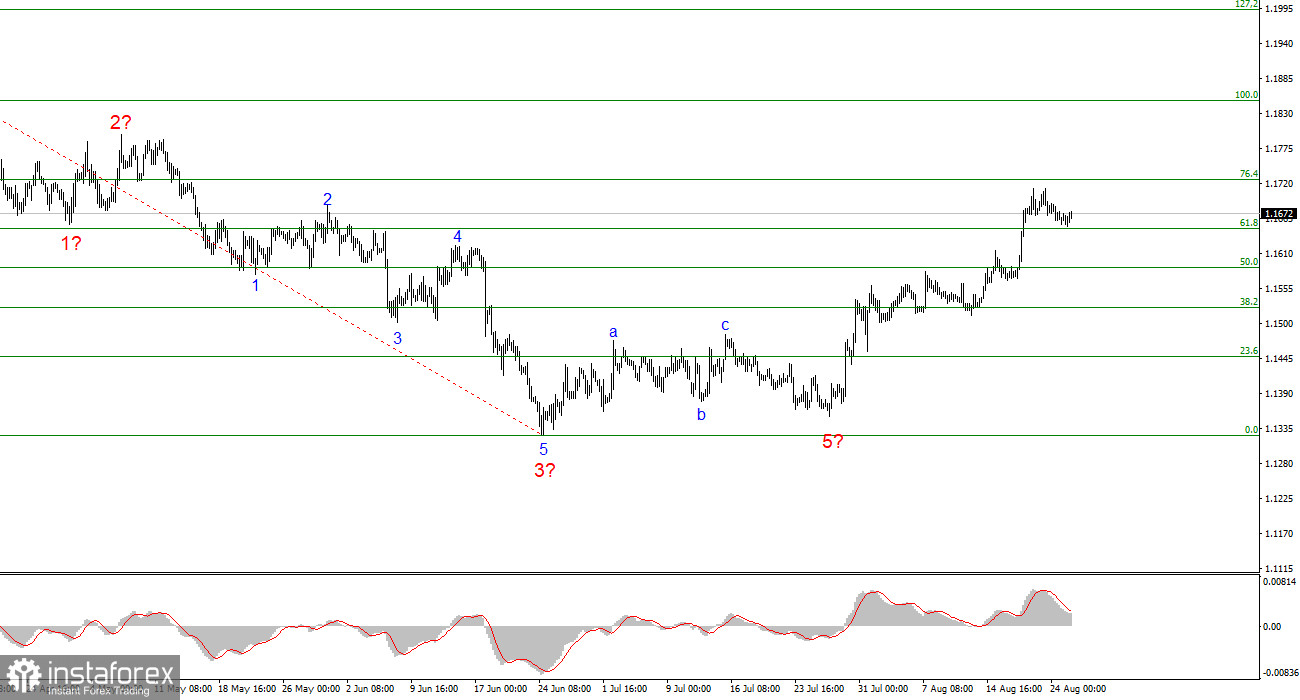
The wave count on the 4-hour chart for EUR/USD is becoming more complex. There is still no question of canceling the upward trend segment (lower chart), which began in January last year. On the contrary, we have seen a complete A-B-C corrective structure that has most likely ended. We never saw a convincing wave 5 of C. This wave took a truncated form, which also occurs from time to time. Let me remind you that classical wave structures are generally found only in textbooks. In real-world markets, traders and analysts need to be more flexible in their analysis. Therefore, I have been saying in my reviews for a month now that traders should prepare for further gains in the euro. If the current wave count is correct, the instrument is at the very beginning of a new upward trend segment.
On the lower timeframe, I can identify a classic five-wave downward structure with a truncated wave 5. I expected the euro to decline to the 13th figure, but the news turned against the dollar, and sellers simply lacked the strength to form a convincing wave 5. Therefore, the formation of a new upward wave sequence can be considered to have begun on July 28.
EUR/USD rose by 10 basis points on Tuesday. The trading range during the day was again limited, although the pair could still gain or lose another 10–20 basis points by the end of the day. However, a more substantial move is currently out of the question. Several reports were released in Germany and the United States today, but they generated no interest or reaction among market participants. I would put it differently: from the outset, none of these reports had any chance of attracting traders' attention. If we exclude the days when the market paused and remained largely flat, the dollar continues to decline sharply. This is particularly clear on the daily chart. Since July 27—that is, for an entire month—there has not been a single strong bearish candlestick or any movement resembling a correction. Therefore, the U.S. currency has been declining for an entire month.
I cannot say that this move was unexpected, as I have repeatedly written in 2026 that the war in Iran was the only factor that supported the dollar. In June, the Fed provided some support for the dollar, but this did not last long. Within a couple of weeks, the market began to question whether the FOMC under Kevin Warsh could deliver on its promises to bring inflation down to its target. Now it is the end of August, and the market's hawkish expectations continue to weaken. No one is expecting monetary policy tightening in September anymore, while Trump's war in the Middle East has effectively stalled. The situation has reached a complete deadlock. Neither Iran nor the United States can make a move that would improve its position. Neither side has a decisive advantage that could be used to bring the conflict to a logical conclusion. Therefore, I believe the U.S. currency could continue to decline even after a month-long fall.
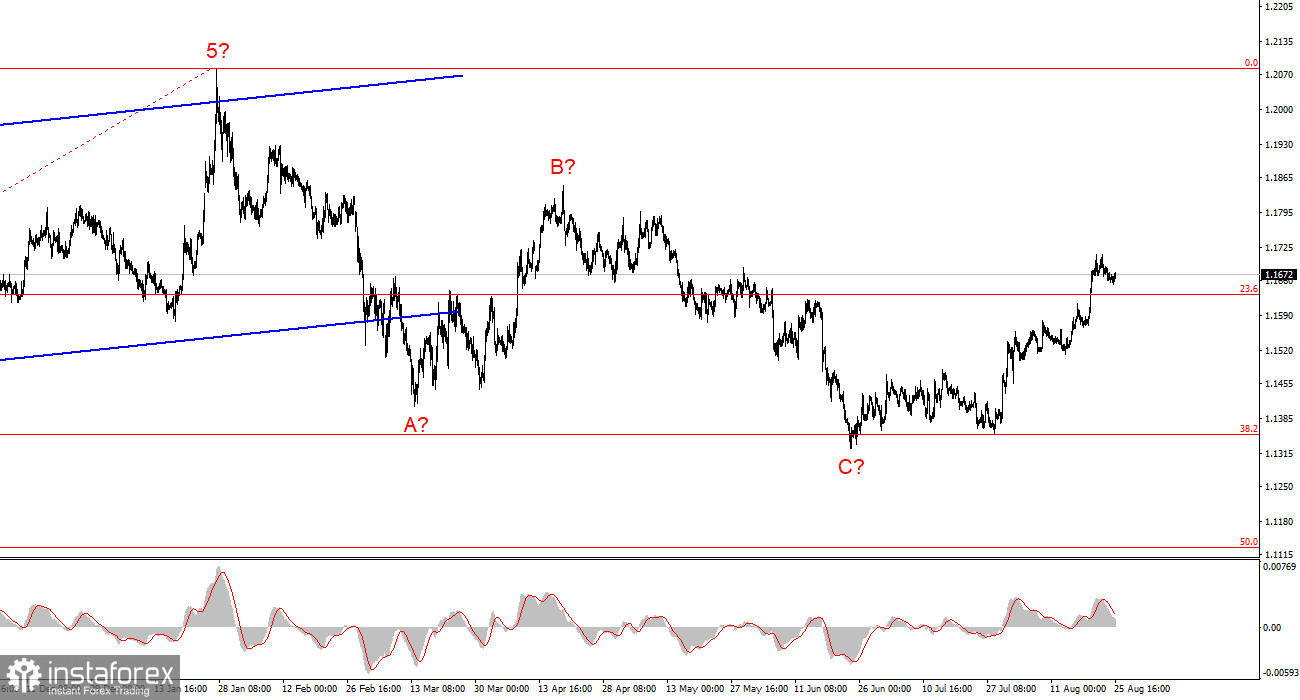
Based on my EUR/USD analysis, I conclude that the pair remains within the upward trend segment (lower chart) and, over the shorter term, has moved into a new upward wave sequence. In my view, this is an excellent time to build long positions. Unless the downward trend segment that began on January 28 develops into a more extended five-wave structure—which would require a strong fundamental backdrop in favor of the dollar—EUR/USD is at the very beginning of a new, prolonged upward trend segment, with targets extending as high as the 25th level.
On the higher timeframe, an upward trend segment can be seen, followed by the formation of a corrective wave sequence. The A-B-C structure is presumably complete. If this is the case, a new impulsive upward trend segment has begun to form.


