
আরও দেখুন


 30.04.2026 04:10 AM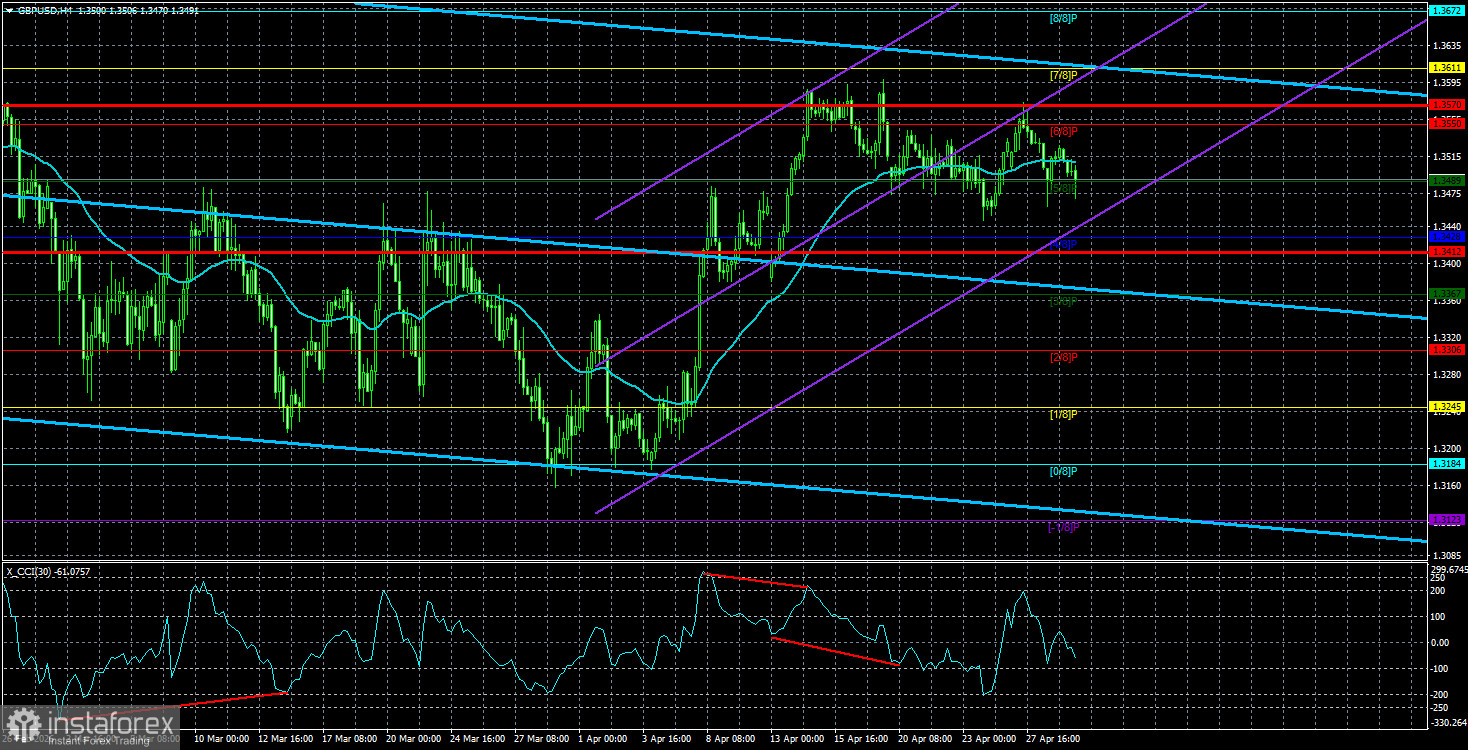
The GBP/USD currency pair also traded in a "neither fish nor fowl" manner on Wednesday. The British pound has been in a sideways range for two weeks now, which is particularly evident on the hourly timeframe. Therefore, it is not really appropriate to talk about any price changes or the influence of various reports on market sentiment. The market continues to pay very little attention to macroeconomic data, and yesterday, among the more or less important reports, only U.S. durable goods orders stood out. Could this report have contributed to ending the sideways range, considering that for the last two months the market has ignored NonFarm Payrolls, the unemployment rate, and all British data (such as last week's reports)?
It should also be noted that this article does not consider the FOMC meeting results or their impact on the technical picture for the GBP/USD pair. Moreover, it is still too early to draw conclusions today, as the market also needs to "digest" the Bank of England's meeting. If we were to expect a surprise, it would indeed come from the British central bank.
The British central bank is the only central bank in the "big three" to share information on voting results for rates immediately after the meeting. Currently, only one member of the BoE Monetary Committee may vote in favor of tightening policy. We believe that in reality, there may be more "hawks" within the committee. It is important to understand how voting forecasts are formed. They are not based on the positions of all Monetary Committee members over the past month and a half but rely on macroeconomic data. The more extreme the data, the more votes are forecasted in favor of a particular decision.
Inflation in the UK rose to 3.3% as of March, and the pace of its acceleration has been much lower than in the U.S. or Europe. Based on this, many believe that the BoE will be the least eager to tighten its policy. However, in fact, inflation in the U.S. and the UK is currently at the same level: 3.3% in the UK, 3.3% in the U.S., and 2.6% in the EU. Thus, the Eurozone is in a position to "wait and watch." The Fed has already taken this position since March. And the BoE currently "has" inflation that is "above the average." Thus, despite the modest March consumer price growth, we believe the BoE is closest to raising the key interest rate.
Therefore, we believe that today several members of the Monetary Committee may take a "hawkish" position in the vote. Will this help the British pound? It's not certain, but it could. Here, it's best to rely on the medium-term trend. It currently remains upward, so any "bullish" factor may subtly play out in the background. We still believe the British pound will rise against the U.S. dollar in 2026, because, under Donald Trump, it cannot be any other way.
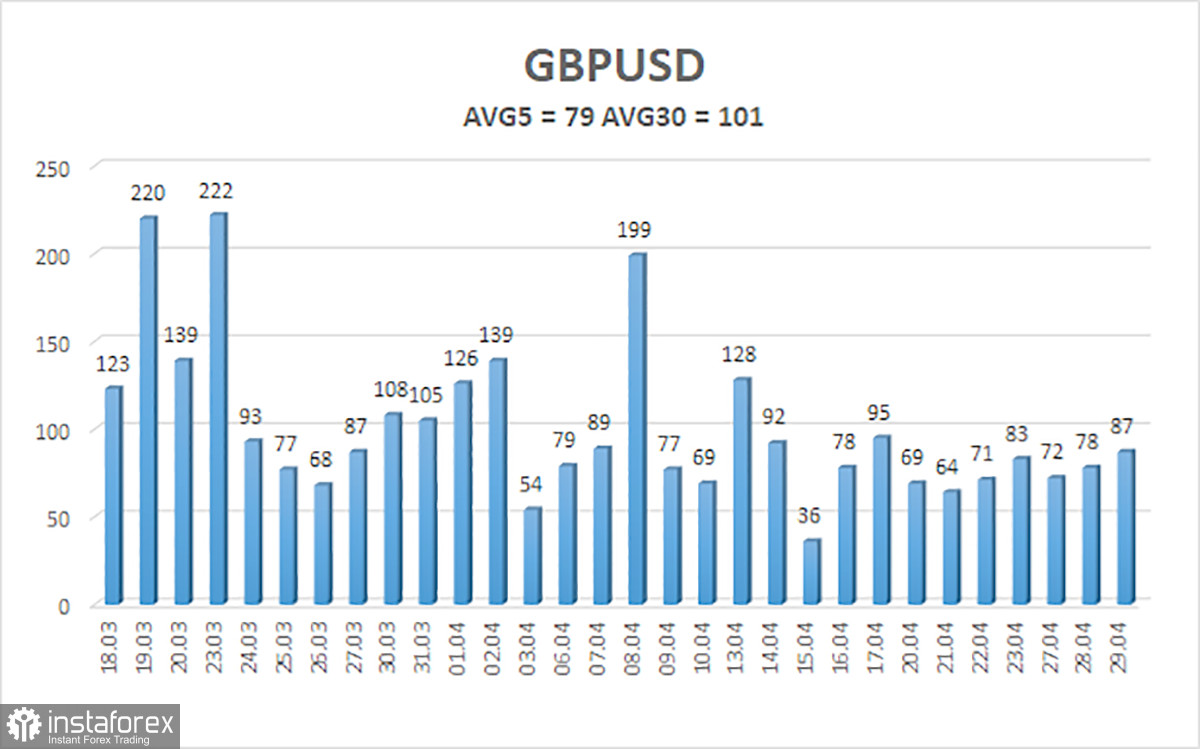
The average volatility of the GBP/USD pair over the last five trading days as of April 30 is 74 pips, classified as "average." On Thursday, we expect movement within the range defined by 1.3412 and 1.3570. The upper linear regression channel is pointing downward, indicating a shift to a downward trend. The CCI indicator has entered the overbought area and formed a "bearish" divergence, which has alerted to a potential downward pullback in advance.
S1 – 1.3489
S2 – 1.3428
S3 – 1.3367
R1 – 1.3550
R2 – 1.3611
R3 – 1.3672
The GBP/USD currency pair continues to recover after two "months of geopolitics." Trump's policies will continue to exert pressure on the U.S. economy, so we do not expect the U.S. currency to grow in 2026. Therefore, long positions with a target of 1.3916 and above remain relevant while the price is above the moving average. If the price is below the moving average line, short positions can be considered with targets of 1.3428 and 1.3412 on technical grounds. In recent weeks, the British currency has recovered, and the influence of geopolitical factors on the market is diminishing.
Linear regression channels help to define the current trend. If both are directed in the same way, it means the trend is currently strong;
The moving average line (settings 20,0, smoothed) determines the short-term trend and the direction in which trading should currently be conducted;
Murray levels are target levels for movements and corrections;
Volatility levels (red lines) indicate the probable price channel in which the pair will operate over the next day, based on current volatility readings;
The CCI indicator – its entrance into the oversold area (below -250) or the overbought area (above +250) indicates that a trend reversal in the opposite direction may be approaching.


